The hard part
A game has about sixteen milliseconds to draw each frame. Python uses a good share of that before any game code runs, which is why 3D engines are rarely written in it. That constraint shaped every design decision here: each choice exists to win those milliseconds back, and the frame rate shows at once whether it worked.
The hot loops are compiled to machine code with Numba, the terrain is raymarched per pixel on the GPU, and lighting is baked into the colour map ahead of time. Everything that is not ground is drawn with instancing, which renders many copies of an object in a single call. Bombs then carve real craters into the live terrain. Every performance change is measured against the previous commit, so a slowdown shows up as a number long before anyone feels it.
2,476 commits on 91 working days since 2026-05-31; every gate verified against a deliberate revert; the showcase's counts generated from the game's own tables.
What the measurements mean
Only what is unusual for this project. Every sentence names the field it came from; nothing here is asserted that cannot be checked against the data.
- At 294,424 authored lines it is one of the larger things here, roughly 35x the median project in this estate. authored_linesfrom authored_lines
- It was changed within the last week, so this is work in progress. activefrom mtime_newest_code
- The code defines 3,829 functions, 2,249 methods and 220 classes. Only 244 of its 247 Python files were parsed, so those are floors rather than totals.see the evidencefrom pythonAst.counts, pythonAst.coverage
- It grades A, weakest on integrity at 90.0%. integrity coveragesee the evidencefrom grades
How it works
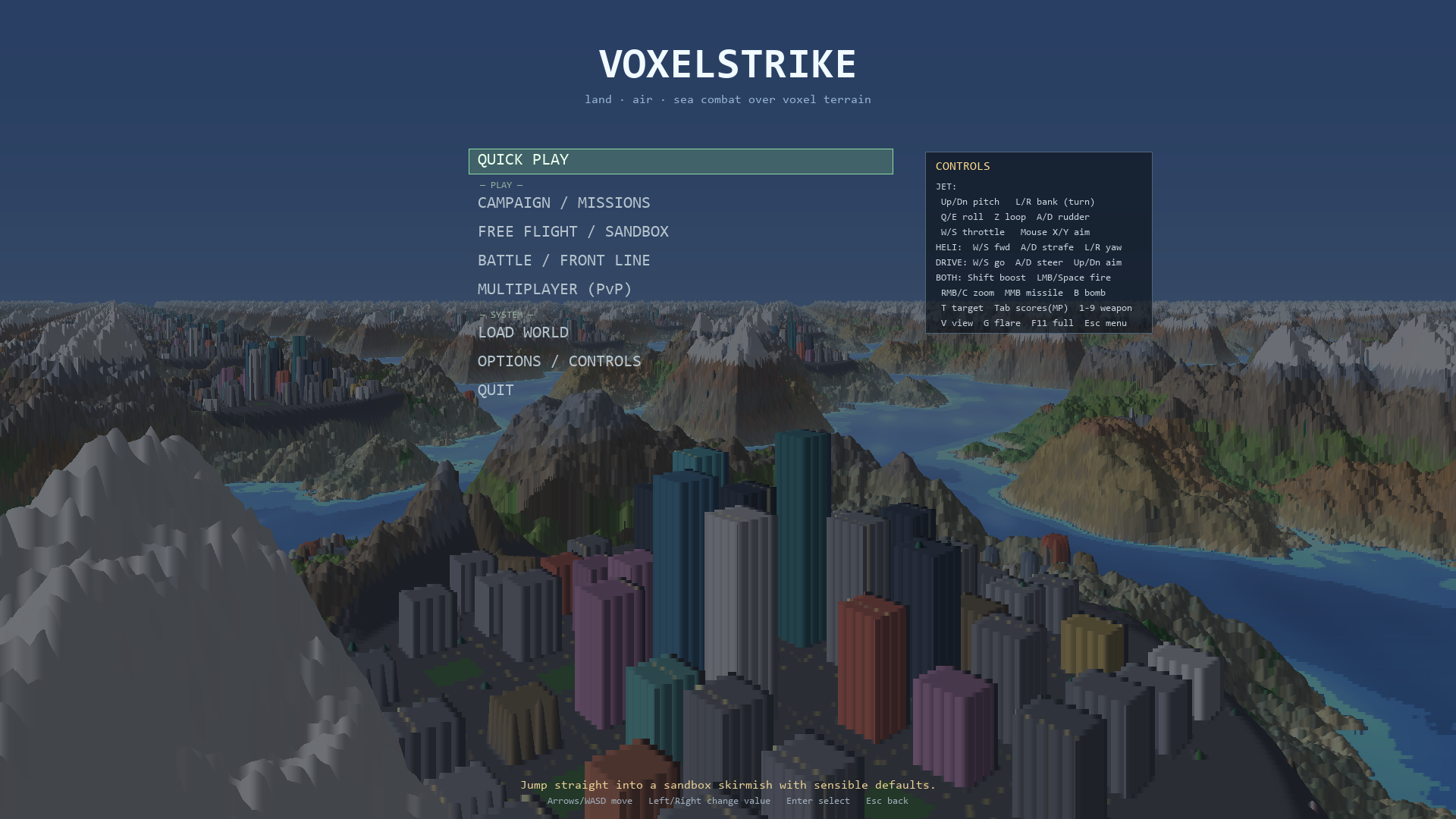
The terrain is a height map plus a colour map, and it is drawn two ways. The first is the classic Voxel Space column raycaster, the technique behind Comanche, compiled with Numba (which turns Python into fast machine code) and run on every core. The second is a GPU raymarch that casts through the same height field for every pixel. That gives a true camera tilted to any angle, so a city seen from above shows real three-dimensional buildings. Voxel models, particles and billboards are drawn in batches on the same path. Craters are carved into the live height map by a single Numba kernel that slumps the rim to its angle of repose, the slope loose ground settles at. That detail matters for play: a machine that drives into a crater can always drive back out. What sets the project apart is how it is developed: nearly every claim is measured, and the measurement is committed. Every check in its headless test battery has been shown to fail when the thing it guards is deliberately reverted. Performance is benchmarked A/B, interleaved against the last commit so that machine load affects both sides equally. Each weapon, machine and mech has its own lab, long runs go to my fleet of machines, and the public showcase is generated from the game's own tables. Its architecture became the starter kit for VoxelBlox.
What it is built from
Each bar is one of this project's own modules, sized by how many times the rest of the project imports it. The counts are measured, not estimated, and the module at the top is the one the rest of the project leans on most.
What kind of engineering this is
Six signals counted from the source: files that run models locally, that act without being asked each time, that check their own output, that survive failure, that touch parsers and protocols, and that were measured then improved. Every axis carries its file count.
What it is written in
Share of code bytes. Vendored bundles and generated output are set aside before this is computed, which is why it differs from a simple file count.
What stands out
- Two renderers over one height field: a Comanche-style column raycaster in Numba and a per-pixel GPU raymarch
- Craters are carved into the live terrain, with rims slumped so a machine can always drive back out
- Every check has been shown to fail on a deliberate revert, and benchmarks run A/B interleaved against the last commit
- Aircraft fly on a lift vector within a real flight envelope, and a tiltrotor has a conversion corridor
- Its architecture became the starter kit VoxelBlox was built from
Capabilities
- Quick start (Windows)
- The battlefield
- What you fly, drive and sail
- Rotorcraft and fixed-wing
- Armour and artillery
- The navy
- Battlemechs
- What makes it a game
- Worlds
- How it works
Grade
Every check names the field it measured. Checks that cannot apply are excluded, never counted as failures.
- provenance100.0%
- documentation100.0%
- runnability100.0%
- maintenance100.0%
- integrity90.0%
Architecture
Directories carrying real modules, largest first.
(root)90 modules
Data model
Typed structures and tables found in the source.
- _Stopped
Vocabulary
Parsed 244 of 247 Python file(s); the rest were over the size budget. Counts are exact; the names below are a sample.
Classes
_nullglfilm.py:191__enter__, __exit__settings_guardlabkit.py:29__enter__, __exit__stats_guardlabkit.py:64__init__, __enter__, __exit__default_settingslabkit.py:113__init__, __enter__, __exit__pinned_targetlabkit.py:321__init__, __enter__, hold, __exit__terrain_guardlabkit.py:369__init__, __enter__, restore, __exit__held_mouselabkit.py:431__init__, __enter__, __exit__held_keyslabkit.py:1286__init__, __enter__, __exit___Statelabkit.py:1304__init__, __getitem__, __len__pinned_serialslabkit.py:1352__init__, reset, __enter__, __exit__subsystem_timeslabkit.py:1449__init__, __enter__, __exit__, ms_per_frame, reportGLCapturelabkit.py:1952__init__, frame, surface, release_Ctxlabkit.py:1959__init__, __getattr___GLShimlabkit.py:2005__init__, __getattr__hud_rectslabkit.py:2074__init__, __enter__, __exit__, last, pixel_overlaps_Clocklabkit.py:2986get_time, __getattr__Benchaim_lab.py:77__init__, _pin, proj, aim, settle, fly, sceneFakeGLcpu_lab.py:62__init__, _upload, render_Screencpu_lab.py:73use_Ctxcpu_lab.py:78_Texcpu_lab.py:83__init__, write_Presentcpu_lab.py:92__init__, layer, sync_ClipOutsitegen.py:368__init__, add, close_Keystrailer.py:635__init__, set, __enter__, __exit__
Functions
_argshot.py:19mainshot.py:27_is_valueshot.py:70_modulesatlas.py:61_str_keysatlas.py:71_tablesatlas.py:82_handkeptatlas.py:111_name_usesatlas.py:144_runtime_tablesatlas.py:181_family_gapatlas.py:231_alias_mapatlas.py:268_walk_own_scopeatlas.py:298_bound_namesatlas.py:310_module_edgesatlas.py:359hitatlas.py:371visitatlas.py:380layersatlas.py:404walkatlas.py:421depth_ofatlas.py:439massatlas.py:477extendatlas.py:517_dead_functionsatlas.py:591driftatlas.py:672knobsatlas.py:722
Command line
- --roots
- --swap
- --batch
- --variant
- --sitting
- --preset
- --forge
- --size
- --seed
- --chunk
Depth
Signals counted from the code, not asserted.
2477 commits across 102 separate working days over 5.4 months, 90 of them revising existing behaviour
Built from scratch
- Renderer / graphics pipeline
- Protocol / wire format
- Parser / lexer
- Audio / DSP
Closes its own loop
- Evaluation / scoring
Proves itself
- Benchmarks
- Golden / baseline files
- Reconciliation / audits
Survives failure
- Timeouts
- Recovery / restore
- Retry / backoff
- Rate limiting
- Fallback paths
Systems
Working within limits
- Throttling / rate limits
- Timeout budgets
Distributed systems
- Worker orchestration
Networking
- Service discovery
Environment engineering
- Virtual environments
Operating-system internals
- Elevation / UAC
Languages
- Python290,657
- Batchfile423
- C628
- Shell64
Built with
- NumPy
- Pillow
- Pygame
- ModernGL
- Numba
- GitHub Actions
- pip
Recurring themes in the commit history
- aim
- check
- hit
- log
- weapon
- round
- ground
- gate
- board
- debris
Evidence
Taken from the code itself: a module docstring or the opening of the README.
VoxelStrike entry point. python main.py Or just double-click run.bat on Windows (sets up the venv automatically).
At a glance
- Status
- active
- Primary language
- Python
- First commit
- 2026-05-31
- Last activity
- 2026-11-11
- Domain
- Games & graphics
- Agent docs
- CLAUDE.md, AGENTS.md, .claude